



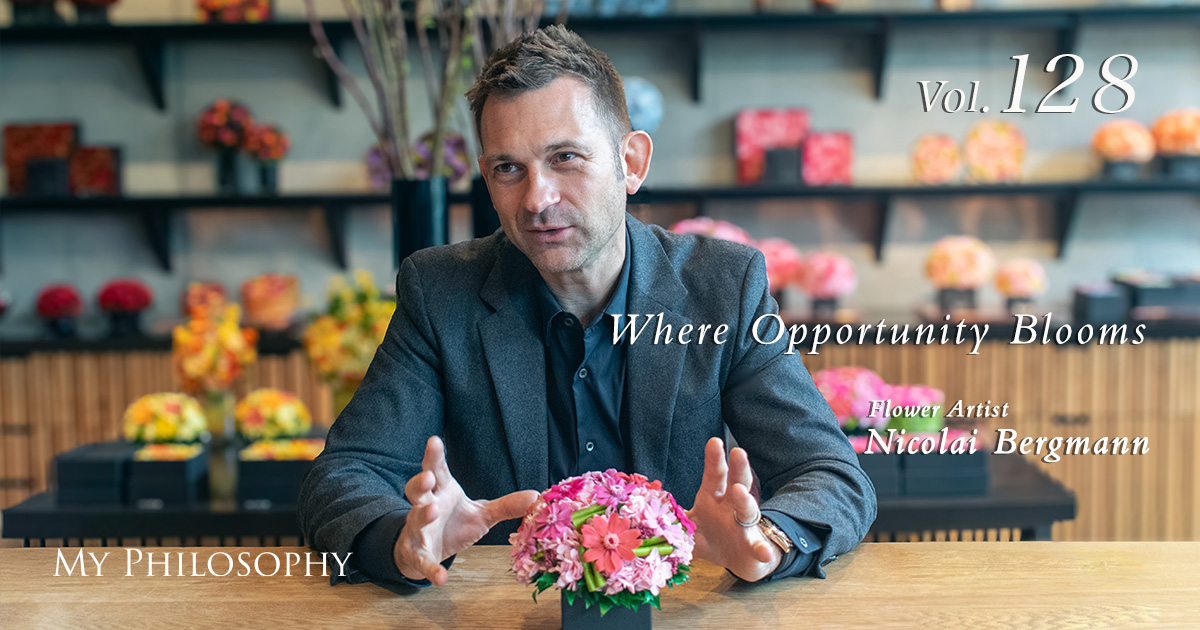
A Danish-born flower artist who has brought a unique style—blending European aesthetics with Japanese sensibility—to the global stage, Nicolai Bergmann believes that “creating an environment where opportunity can emerge is essential.”
His iconic “flower box” was born out of a moment of uncertainty, when he found himself thinking, “I don’t know what to do.” Now, a quarter century since launching his brand, we explore Bergmann’s journey, his sources of inspiration, and what lies ahead.
Profile
Vol.128 Nicolai Bergmann
Flower Artist
Born in Denmark in 1976, Nicolai Bergmann is a Copenhagen-born flower artist based in Tokyo. Known for his distinctive style, he combines European design foundations with Nordic aesthetics and a meticulous, detail-oriented Japanese sensibility.
He came to Japan in 1998 and founded Nicolai Bergmann Flowers & Design in 2001, opening his first shop. In 2010, he launched a flagship store in Minami-Aoyama, complete with a café and studio. Today, he operates nine flower boutiques—including seven in Japan, as well as locations in Copenhagen and Seoul—and the Nicolai Bergmann Hakone Gardens in Gora, Hakone.
Beyond floral design, he has collaborated with leading global companies across fashion and design, and actively presents solo exhibitions of his flower art in Denmark and across Asia. In 2025, he held a major exhibition in Copenhagen’s Tivoli Gardens to celebrate the 25th anniversary of the flower box—continuing his dynamic presence on the international stage.
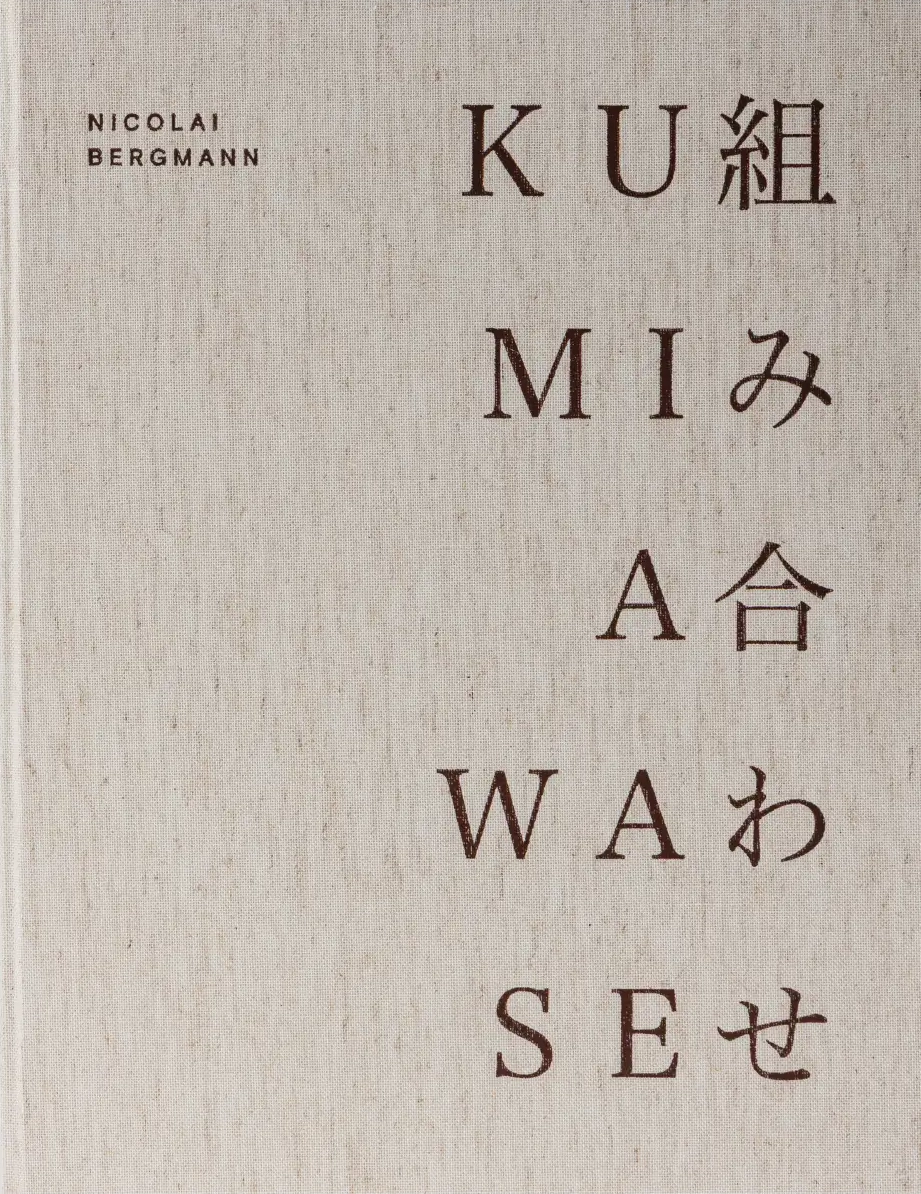
In September 2026, he published a new flower art book, “KUMIAWASE”, a collection of his works accompanied by his own words.
His publications also include “Good Endurance: Words of Effort to Achieve Dreams Found in Japan” (Asa Publishing) and “Nicolai Bergmann: Bringing Flowers and Happiness into Everyday Life” (Kanki Publishing), among others.
Nicolai Bergmann | Official Website
Original Flower Box 25th Anniversary Special Website
Nicolai Bergmann Official Instagram
What Flowers Teach Me
—The Source of Creativity Is “Love”
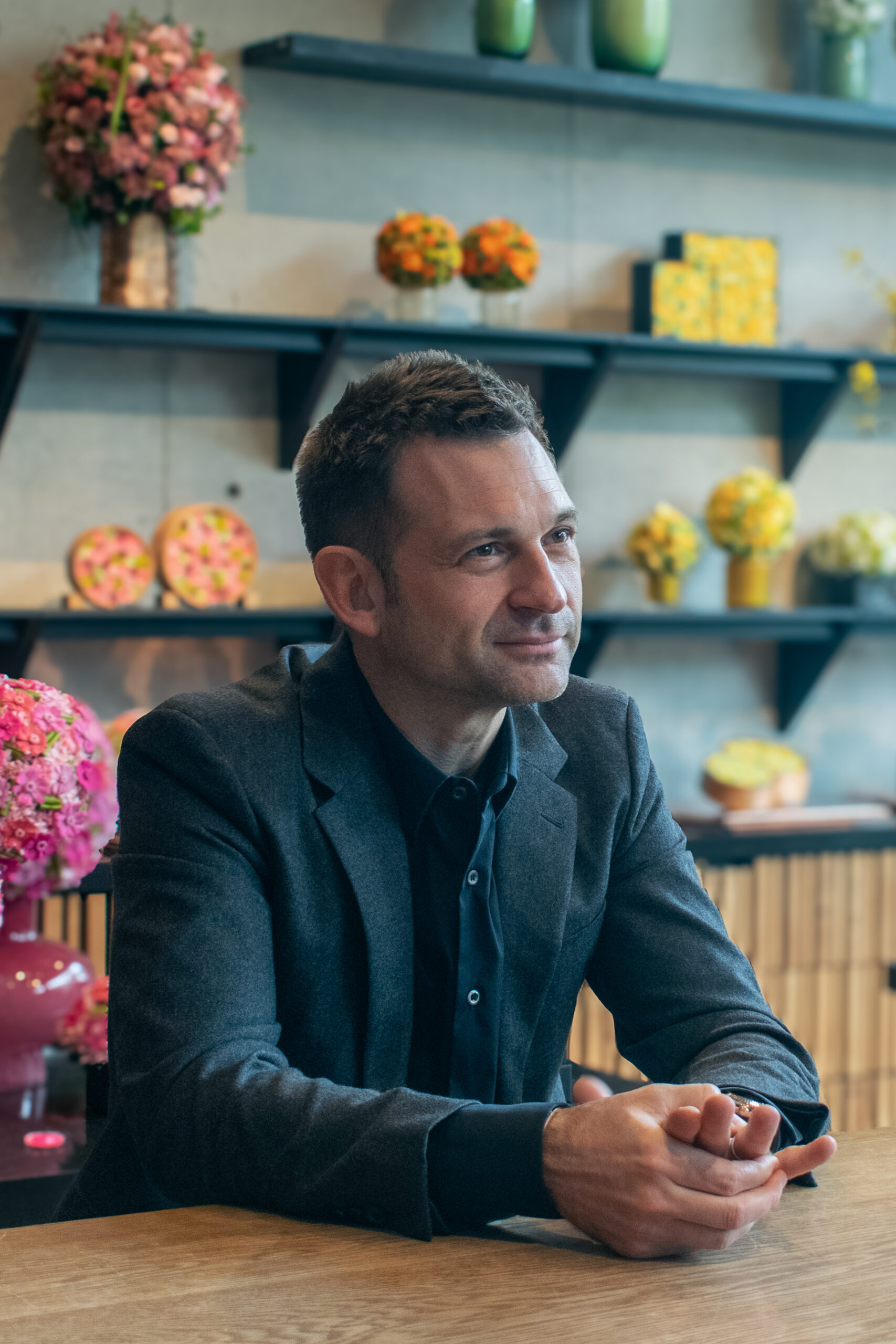
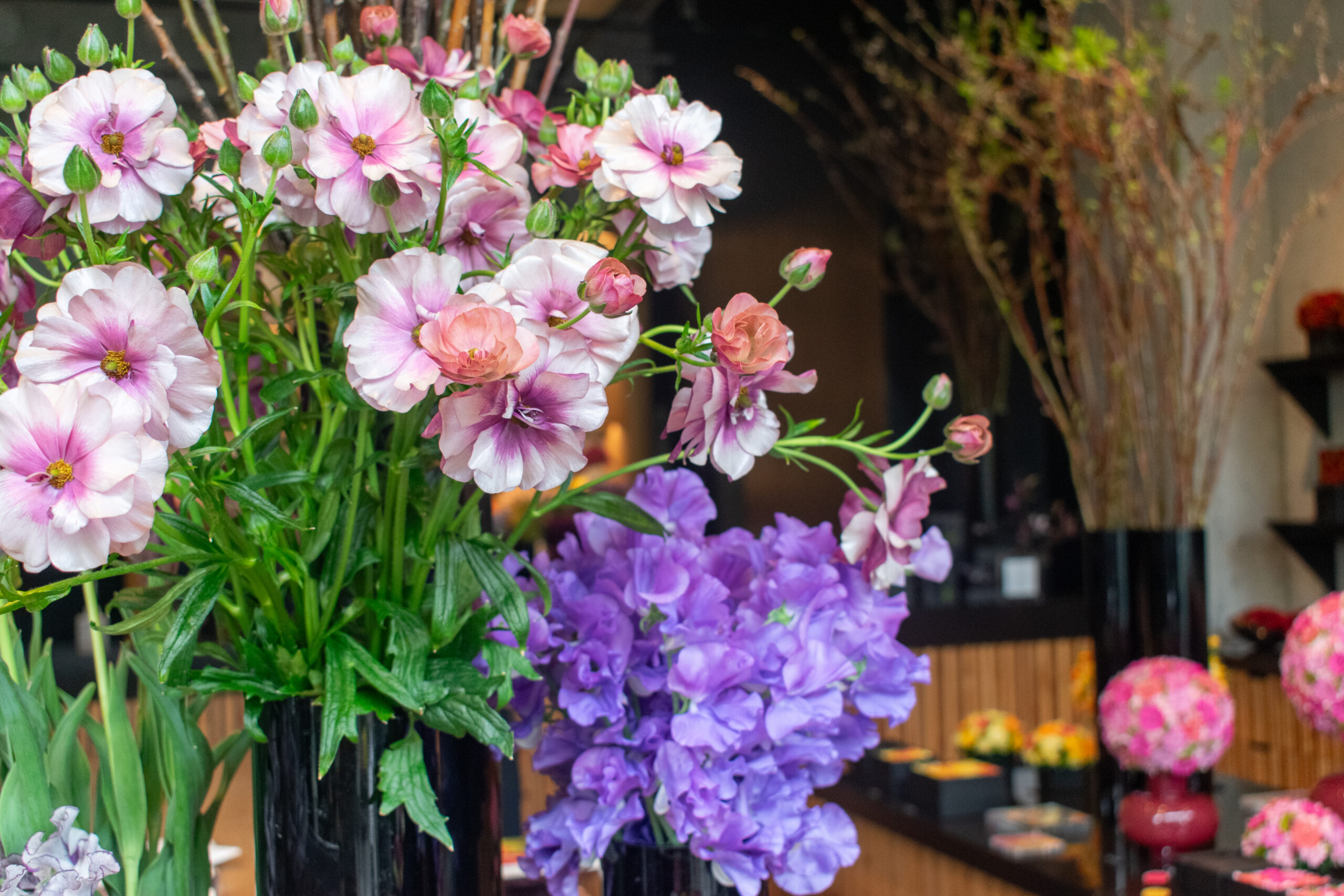
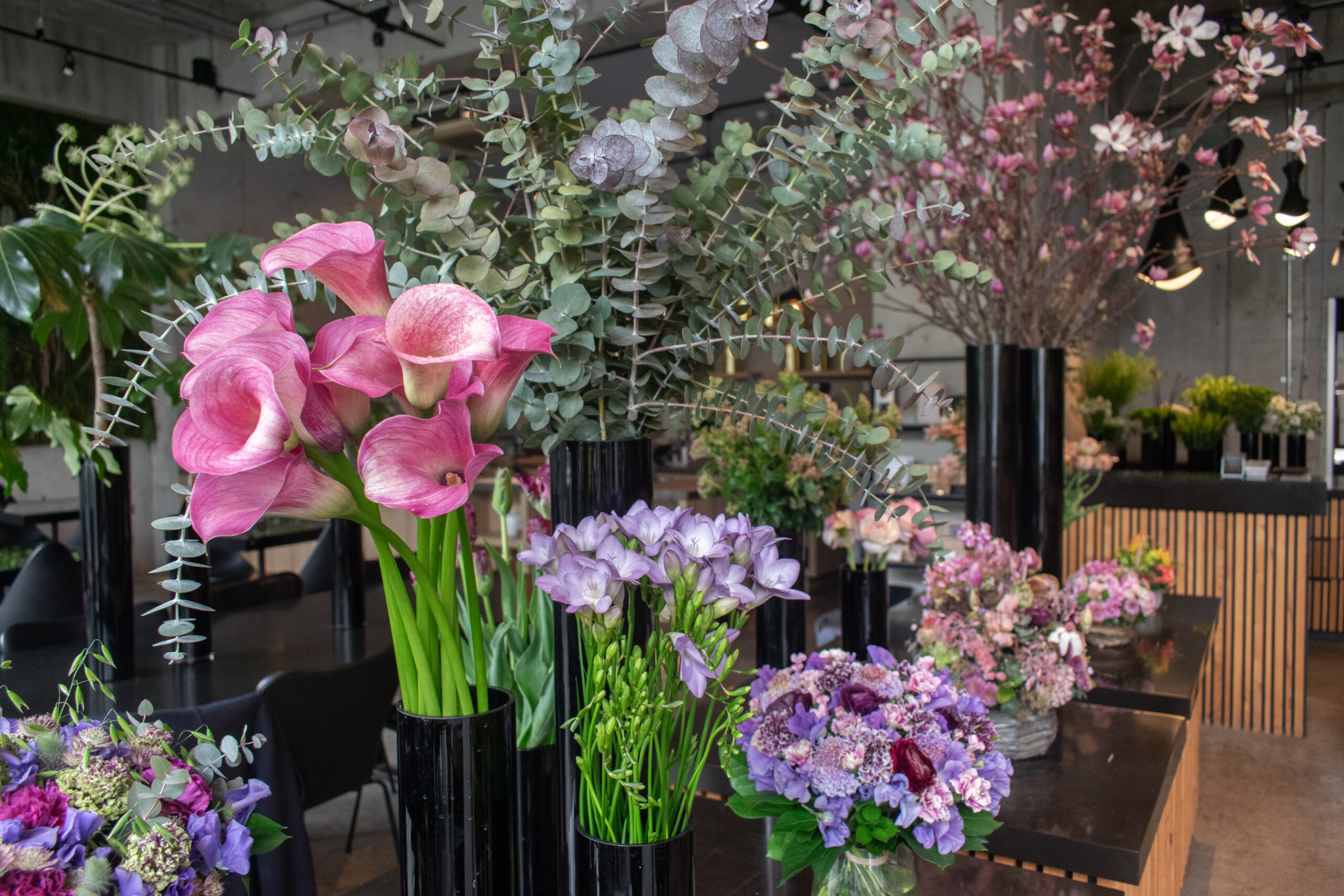
Flowers are my greatest source of inspiration. That’s why I still visit the flower market once a week. If I stay away for too long, my creativity simply doesn’t flow.
Looking at flowers allows me to feel the changing seasons. I truly enjoy those moments of thinking, “The tulip season is almost over—perhaps it’s time to shift to something more summery next.”
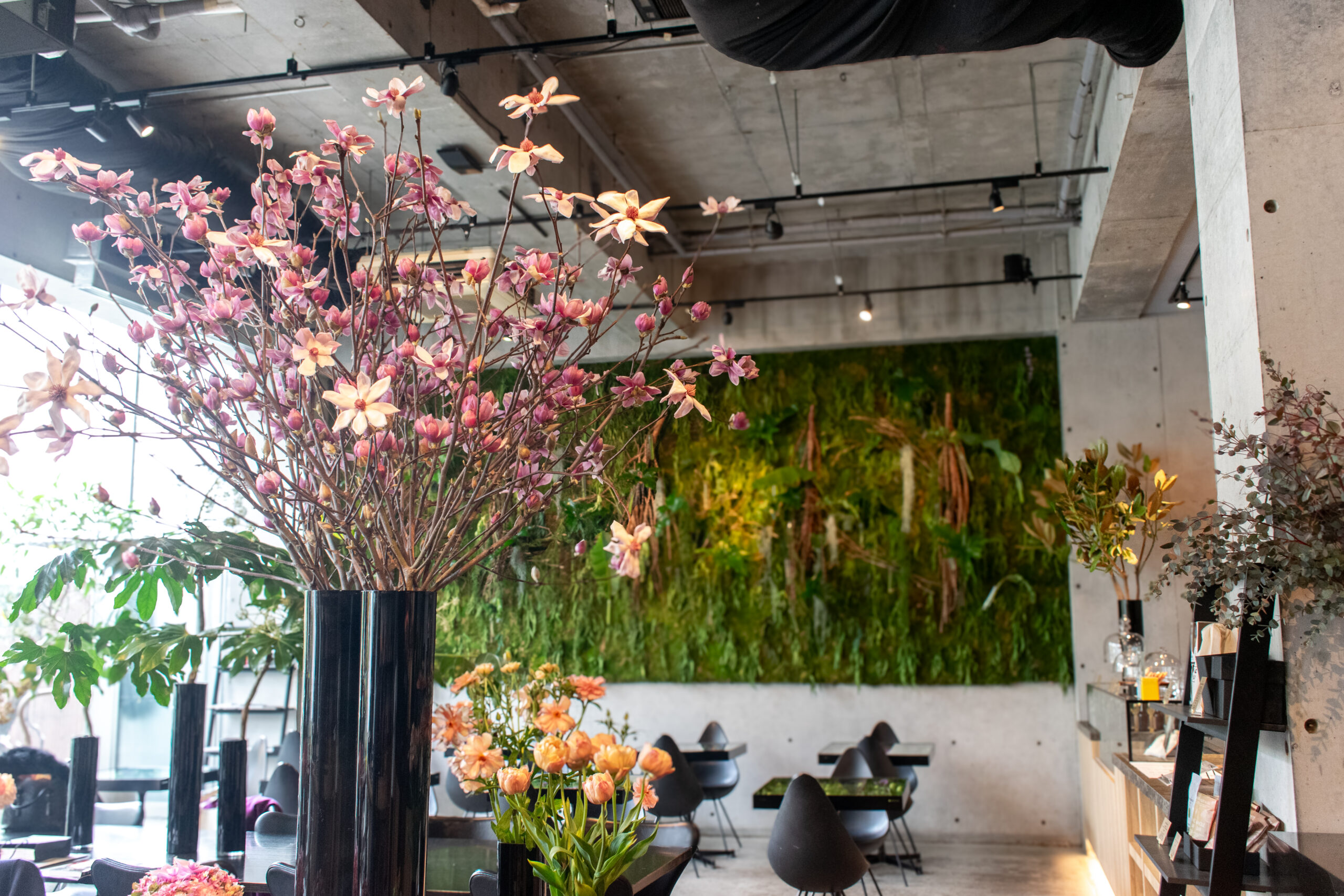
I sometimes bring in seasonal flowers a little earlier, or use them slightly past their peak, as if holding on to them just a bit longer. Some say that flower art is “art with an expiration date.” But precisely because it changes every week, it creates a natural rhythm within a space.
Because I value this sense so deeply, I used to visit the Ota Market three times a week—on Mondays, Wednesdays, and Fridays—waking up at 3 or 4 in the morning. I don’t quite have the energy for that anymore, though (laughs).
Through all the years I’ve spent working with flowers, one truth has become clear to me: the most important thing is that the creator genuinely feels a sense of love and joy.
“Nicolai Bergmann Flowers & Design” exists because of the flowers themselves. The moment working with flowers becomes routine, the soul disappears from what we create.
So even as the brand continues to grow, the ongoing challenge is how to preserve both the beauty of the flowers and the designers’ genuine love for them.
Flower Boxes Inspired by a Problem
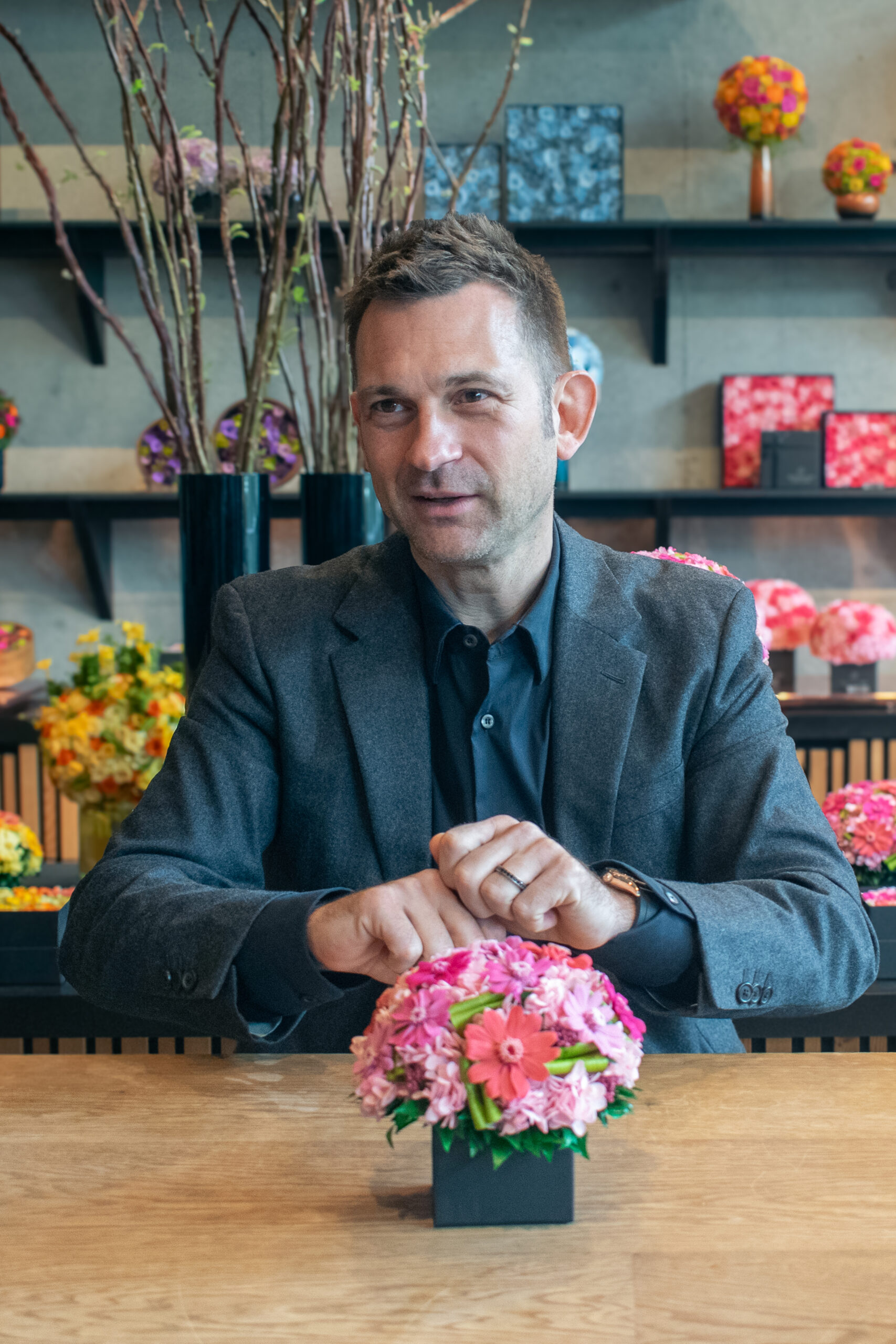
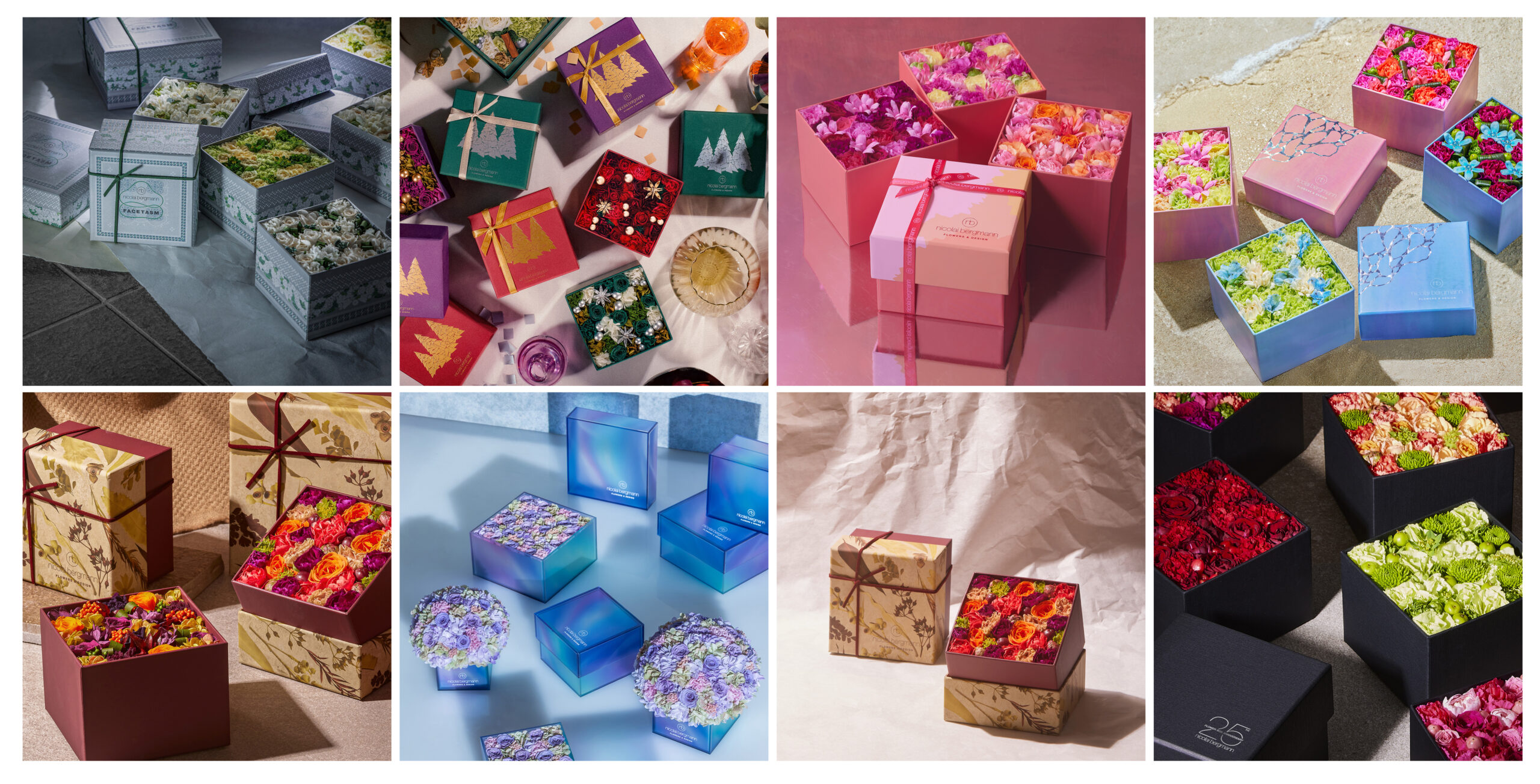
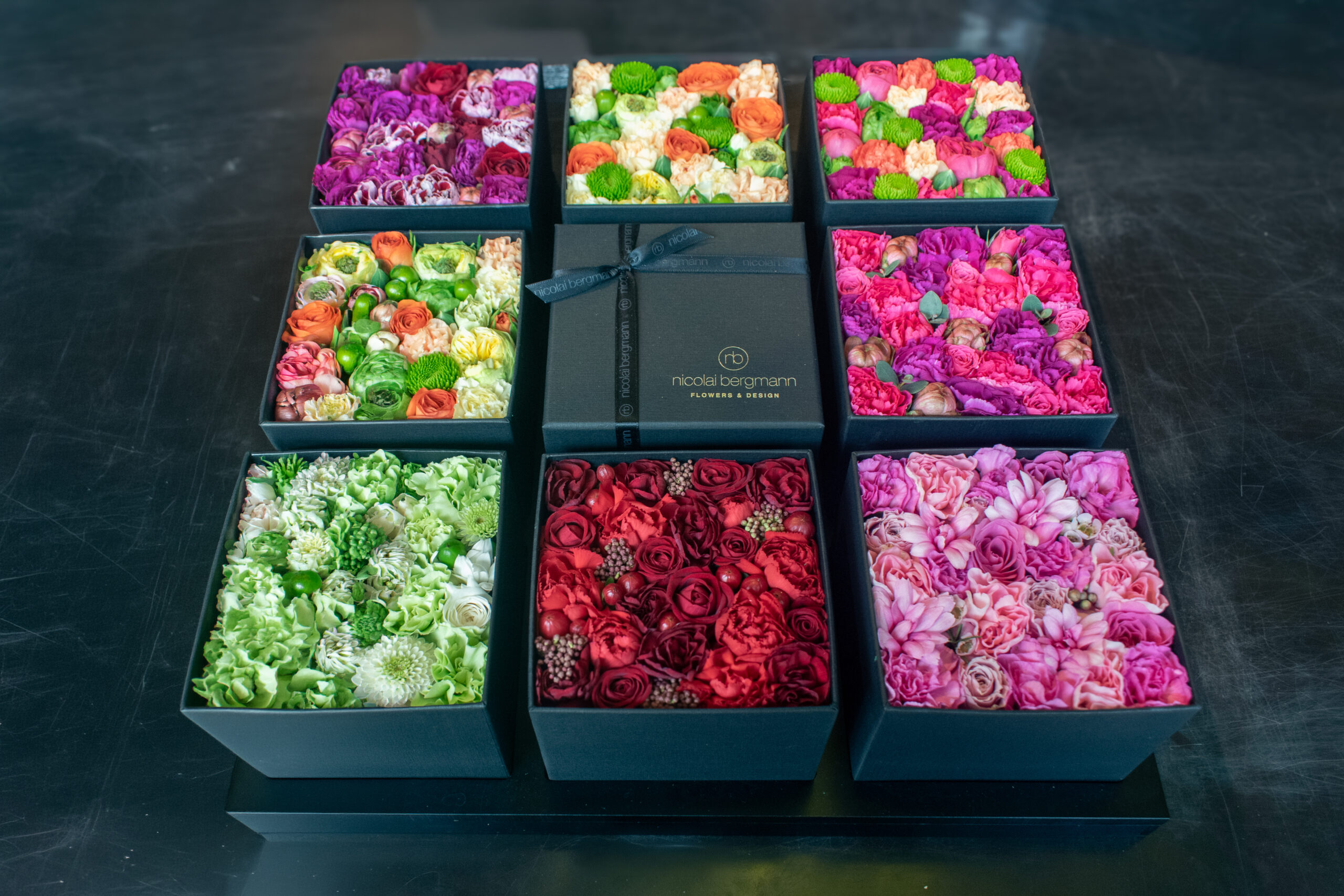
Today, the “flower box” has become a standard in floral gifts. But it was born from a moment of uncertainty—when I found myself thinking, “I’m stuck. What should I do?”
At the time, I had just been put in charge of a shop at the flower store where I was working, and I wanted to prove both the value of the shop and my own role within it. That was when I was asked to present an idea for 600 flower gifts.
The request was to propose floral gifts as party favors, but the venue was small and space was limited. Under those conditions, the only solution was to create something that could be stacked.
I began by creating floral arrangements using baskets and containers, going around places like Tokyu Hands and LOFT to collect boxes and place the arrangements inside them. However, it quickly became clear that using both containers and boxes was not feasible within the budget.
So I went to the wholesale district in Asakusabashi, found suitable boxes, assembled them myself, and arranged the flowers directly inside. The need to stack them, combined with strict budget constraints, pushed me into a difficult situation—but it was precisely that challenge that led to a new idea.
The result of the presentation was surprisingly anticlimactic.
“It’s lovely. It’s beautiful. But we’ve decided to go with something else. Thank you.” That was it.
Unfortunately, it didn’t lead to any work. Yet the idea I came up with at that moment would later become the “flower box,” a defining symbol of my brand. At the time, I couldn’t have imagined it.
When things are going well, our thinking tends to become complacent. But when we are truly pushed to our limits, our minds begin to operate at full capacity.
In particular, many people overseas are reluctant to use words like “coincidence” or “chance,” perhaps because they feel it diminishes their own effort or ability. But in reality, both coincidence and luck are things that emerge when you are fully engaged and giving your all.
They don’t come to you while you’re lying on the sofa at home. In that sense, I believe the environment you create for yourself is incredibly important.
“Good Endurance”
—Words that Transform Negativity into Strength

I often use the phrase “good endurance.” While there are words like “motivation” or “doing your best,” I’ve always felt that the word “endurance” isn’t usually used in a positive way. Enduring something is often associated with hardship, and when you say, “You should endure more,” it tends to carry a somewhat heavy, negative tone.
However, in order to accomplish something meaningful, endurance is also necessary. There are things that simply cannot be achieved without it.
The kind of endurance that leads to your dreams and goals is what I call “good endurance” —something worth experiencing. Life comes with its share of hardships, but I believe in moving forward with a positive mindset, striving toward your dreams.
“Good endurance” is a phrase I use to redefine the negative image often associated with endurance and to give it a more positive meaning.
What I Learned from My Grandfather’s Apple Orchard
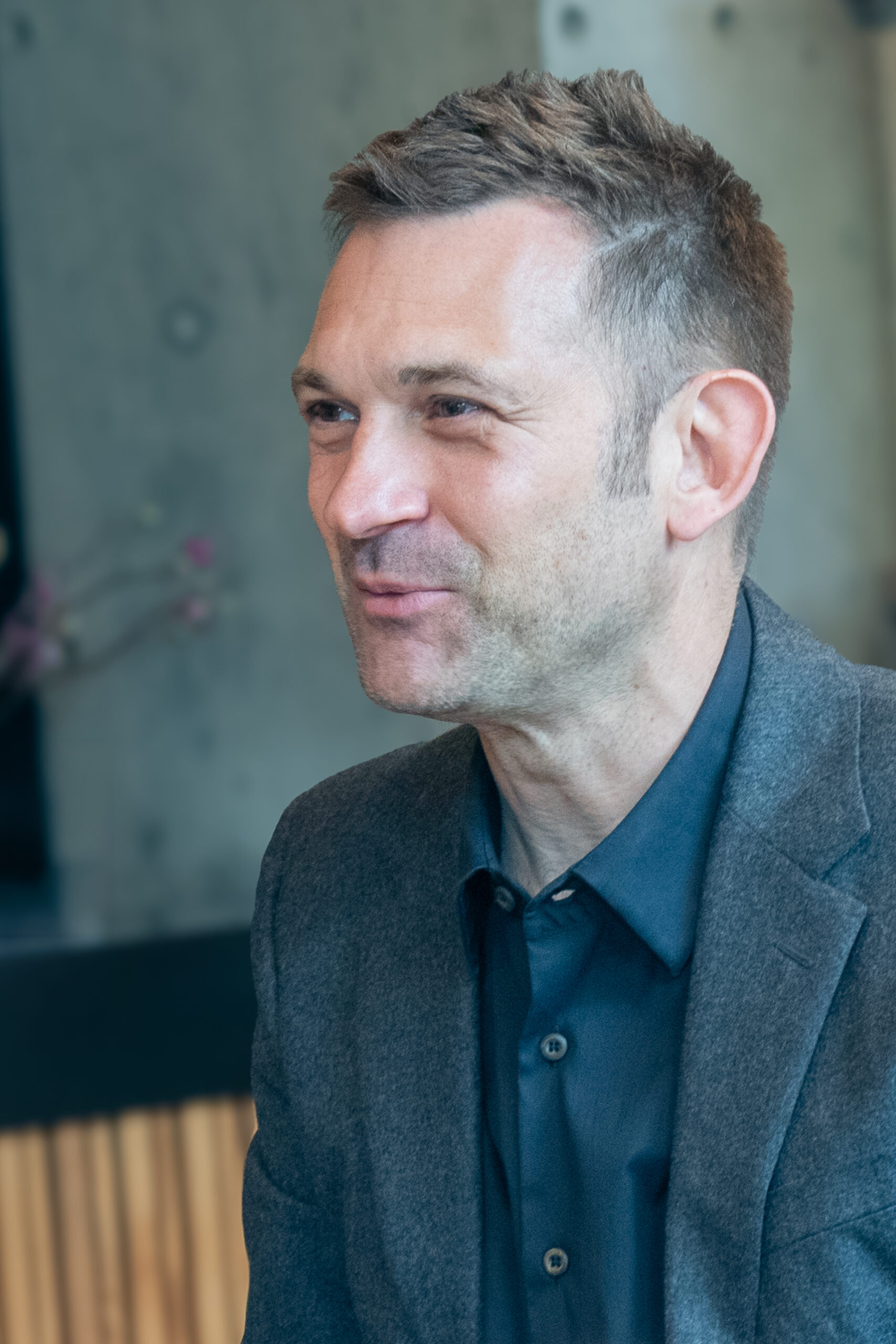
This sense of “good endurance” may have been something close to me since childhood. My grandfather ran an apple orchard, and he would often say, “You may have things you want to do, but you don’t have the money. So first, think about what you can do with what you have now.”
My father also went through a difficult time, burdened with a debt of 60 million yen. But rather than relying on others, he kept asking himself what he could do in his current situation.
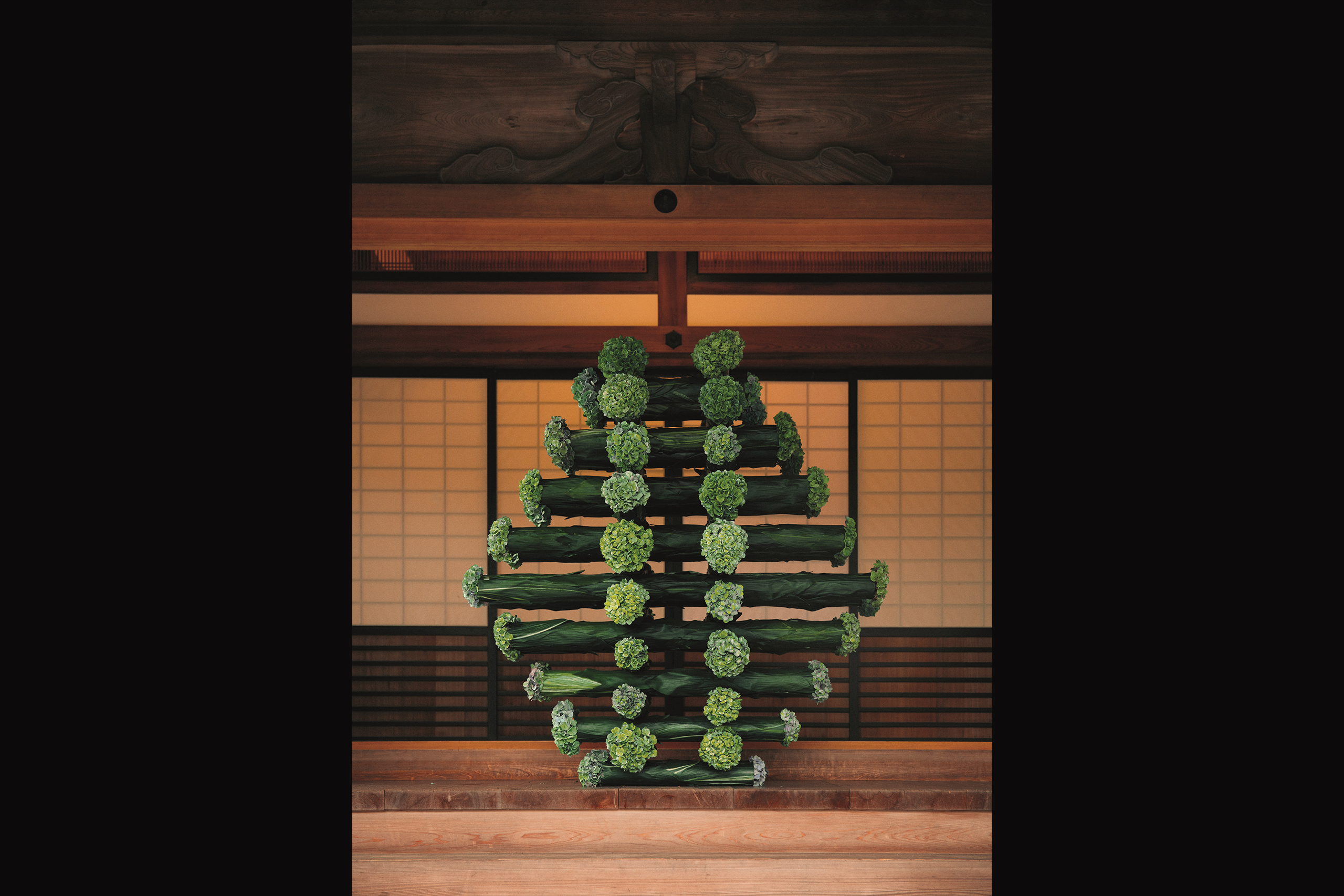
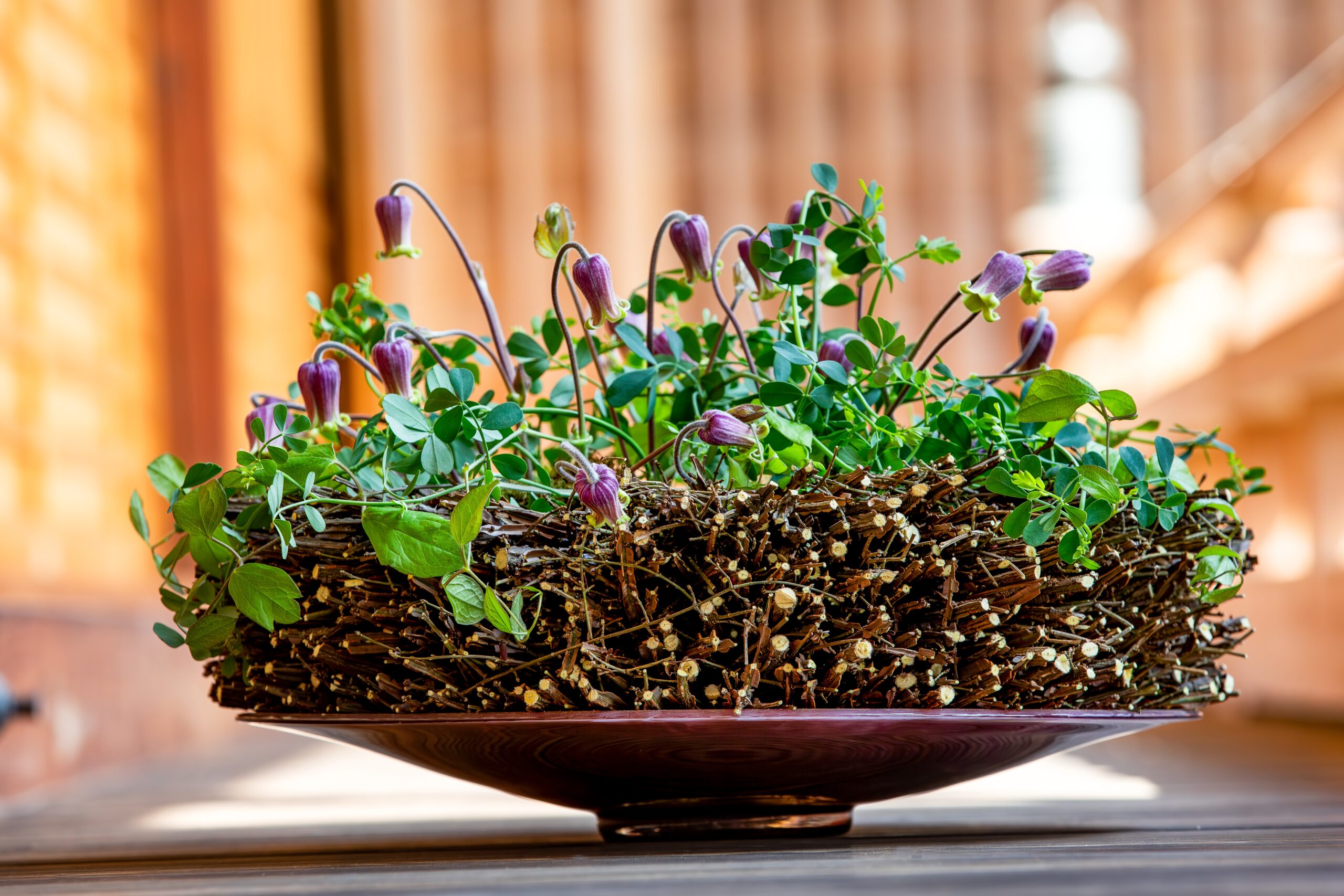
If I were to express “endurance” through flowers, I would focus intensely on the details. I would weave fine pieces of bamboo to create a vessel, and use slightly darker tones—deep purples or near-black shades, like chocolate cosmos—to shape the composition.
And then, within that, I would add a single accent color. It represents a ray of light that exists within endurance.
Compared to other countries, I sometimes feel that Japan has fewer positive expressions.
There was once someone at the flower market who would always complain, saying things like, “Nothing sells,” or “The staff won’t work.” One day, I found myself saying, “If you keep saying that every day, things will never sell.”
Later, that person came back to thank me. Apparently, my words made them realize how often they had been speaking negatively. From that point on, they made an effort to stop using negative language—and as a result, their staff’s attitude improved, and their sales increased as well.
You often hear in books that if you keep saying “I’m bad,” you’ll eventually become that, and if you keep saying “I’m good,” you’ll become good. Of course, it’s not that simple—but I do believe that our minds and bodies naturally resist negative words.
My Philosophy
—Between Nature and the Balance of East and West
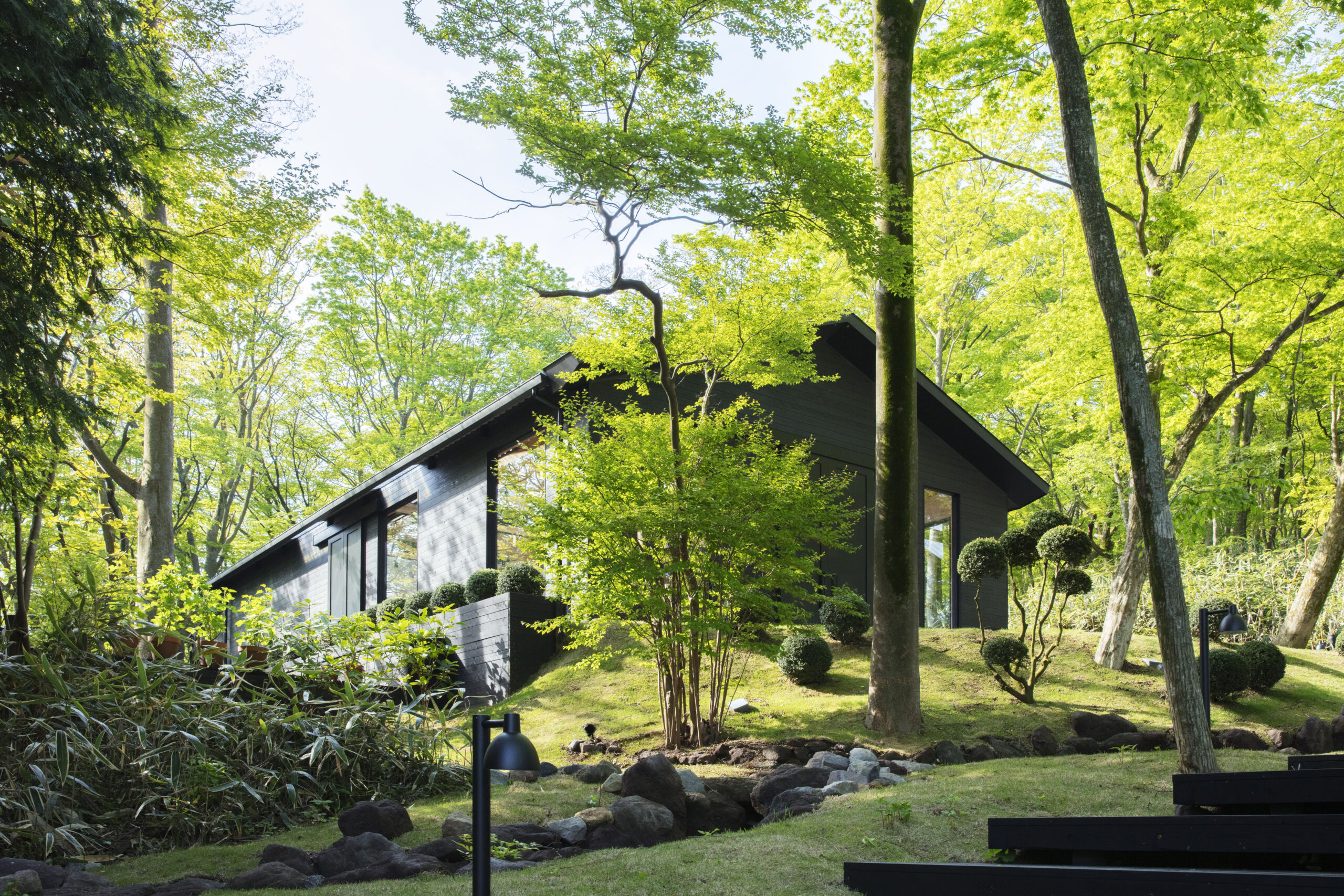
There are several sources of inspiration when I create my work. The flower market I mentioned earlier is one of them, but above all, nature plays the most significant role. When I connect with the simplicity of nature, it fills me with a deep sense of energy.
In 2022, I opened“Nicolai Bergmann Hakone Gardens” as a place where people can connect with nature. Simply going there and taking in the scenery is enough to restore my energy.
I am also inspired by two flower artists I admire. One is Tage Andersen from Denmark, whose unique worldview is truly remarkable. The other is Daniel Ost from Belgium. Although their styles are very different, I have great respect for both of them. However, I am not directly influenced by the work of other flower artists.
Rather, I often find inspiration in architecture and space—particularly in the works of Kengo Kuma and Tadao Ando—as well as in interior design as a whole.
In September 2026, I have published “KUMIAWASE” *1, a commemorative flower art book marking the 25th anniversary of the flower box. It features a selection of my work to date, accompanied by my own words.
The book is built around a fusion of Japanese and Western aesthetics, and for the first time, I collaborated with a Danish graphic designer on its production.The cover incorporates Japanese kanji—something that likely wouldn’t have happened had I worked with a Japanese designer. From an international perspective, kanji appears striking and visually compelling.
Looking back now, I truly feel that it was invaluable to have traveled deep into Japan and experienced it firsthand—at a time before computers and social media existed.
Although we now live in what is often called the digital age, I believe it is those real, lived experiences that have become the foundation of who I am today.
This book is filled with everything I felt and encountered during that time.
*1KUMIAWASE means “combination” or “arrangement” in Japanese, reflecting the interplay of elements, materials, and aesthetics.
Japan and Denmark
—Shaped by Two Places
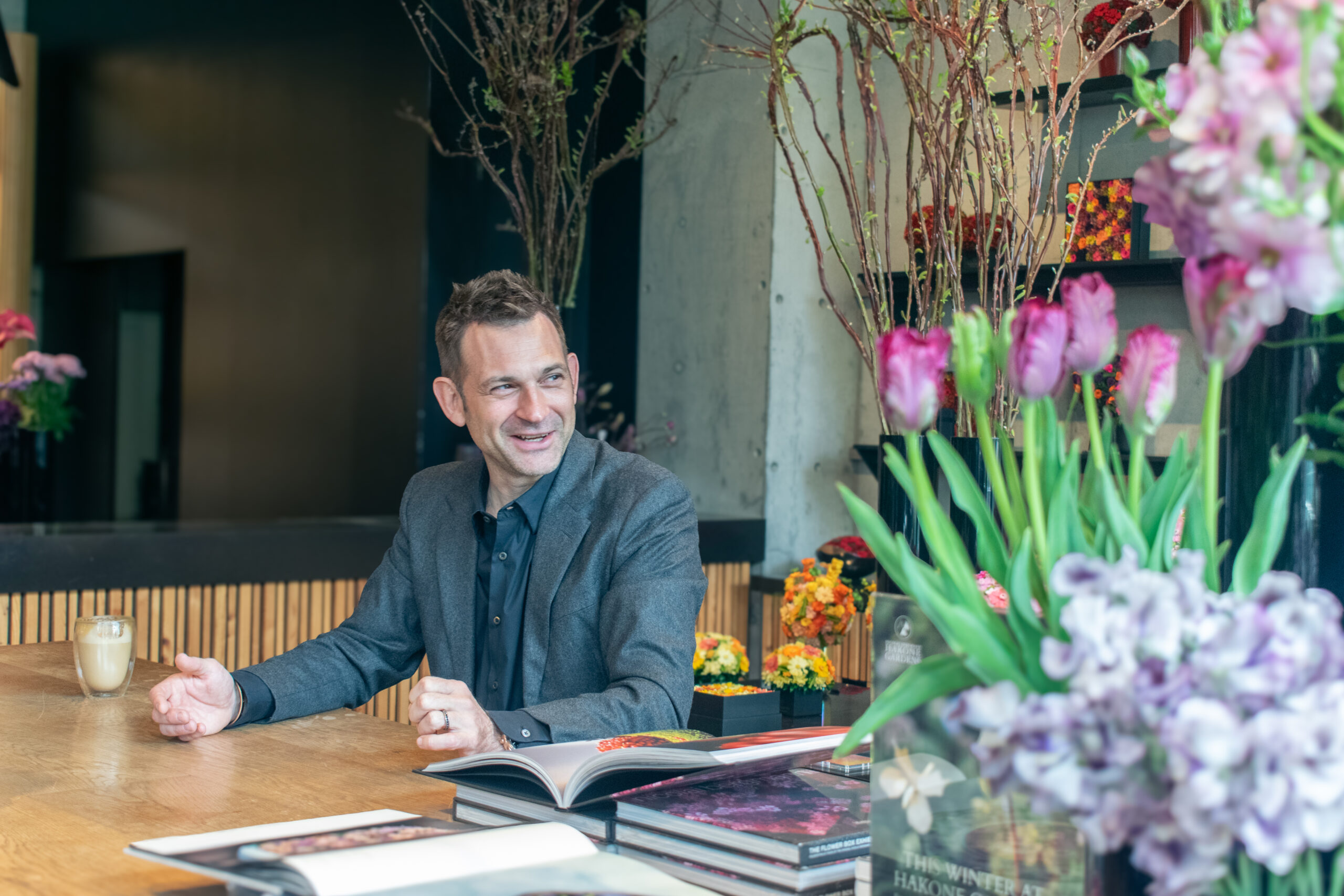
As I grow older, I see myself continuing to live in Japan. If I were asked to choose between Denmark and Japan, I might choose Denmark. But whenever I return to Denmark for about a month each season, I feel a deep sense of comfort. That balance is important to me.
There was a time, especially during my first seven years, when I couldn’t return to Denmark at all, and it was truly difficult. But looking back now, I see that period as “good endurance.”
Flowers are honest. The creator’s love is conveyed the moment the box is opened. To create that single moment, I want to continue building an environment where I can keep moving forward.
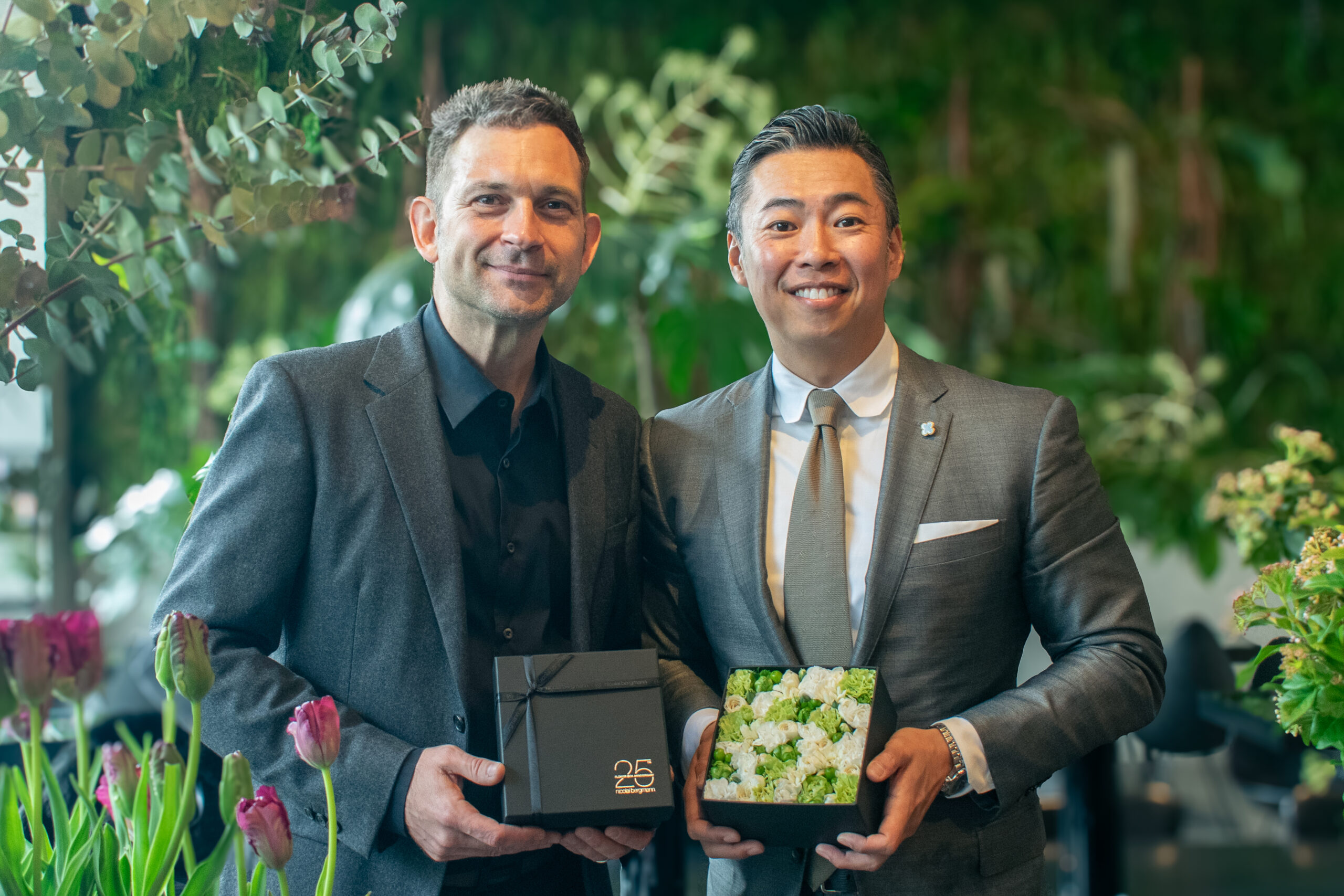
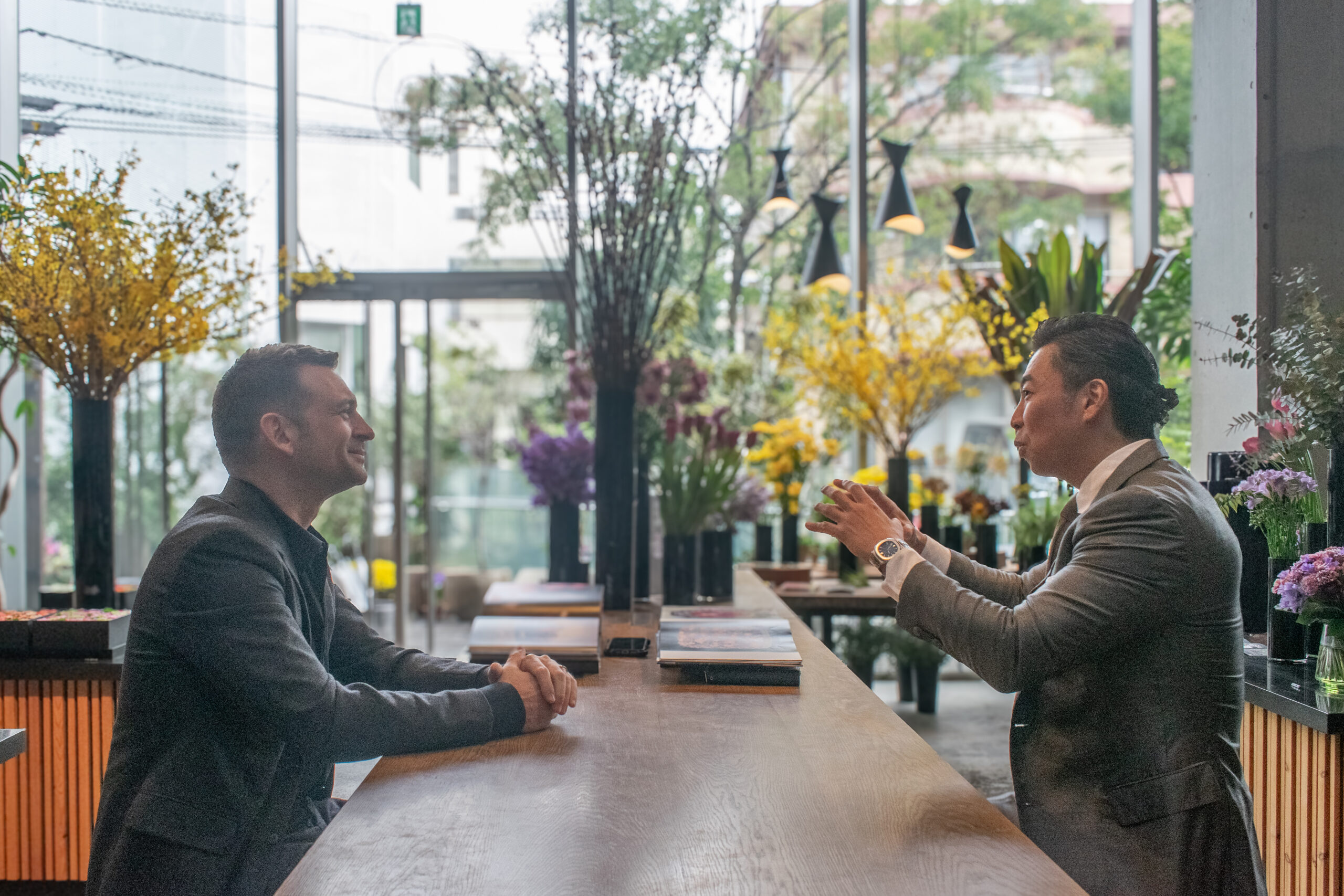
The conversation with Mr. Sugiyama was a truly enjoyable experience. As fellow entrepreneurs who have both overcome various challenges, we found many points in common.
Although it was our first time meeting, I felt a very positive energy from Mr. Sugiyama. I also value taking on new challenges and maintaining a positive mindset, so I found the exchange both inspiring and stimulating.
I am confident that Mr. Sugiyama will achieve his goal of reaching 1,000 interviews for My Philosophy.
Nicolai Bergmann, Flower Artist
I first encountered Nicolai Bergmann’s flower boxes about 15 years ago. It was before the current flagship store was renovated—I came across them in a space I visited with a friend.
When I gave one as a gift, I saw that unmistakable “wow” expression the moment the box was opened—the entire atmosphere shifted in that instant. That experience made me realize what true value is.
One of the directors at my company has had a relationship with Nicolai for over 30 years, and since the early days, flowers have been delivered to his house every week. Over time, we’ve displayed more than 1,000 varieties. While flowers typically last about a week, there are times when they fade quickly, depending on the energy of the people who enter the space. I believe flowers reflect both the environment and the state of those within it.
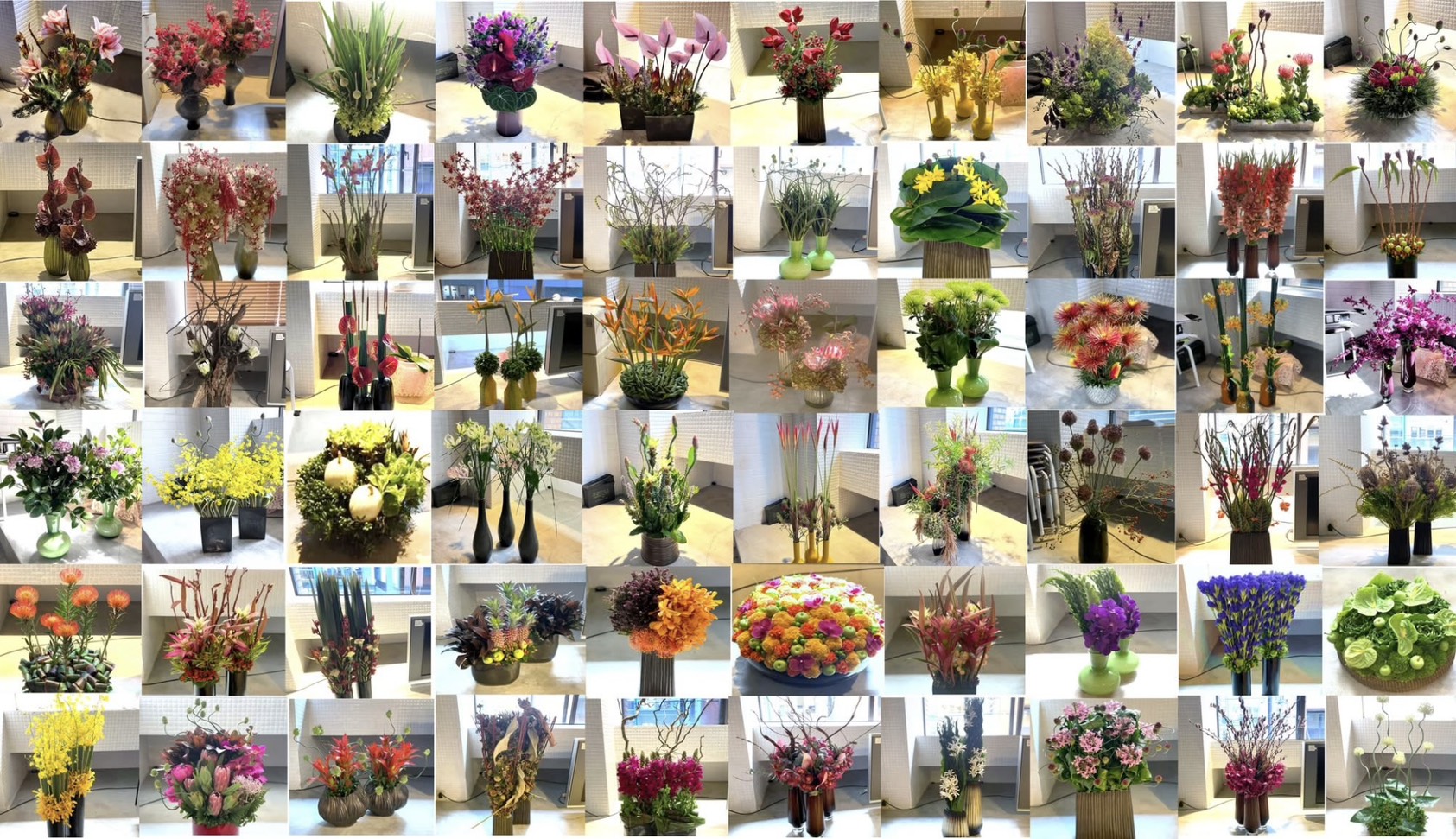
There is a soul in Nicolai’s creations. That is why they have the power to transform a space and move people’s hearts. This is not simply floral design—it is the creation of an environment itself.
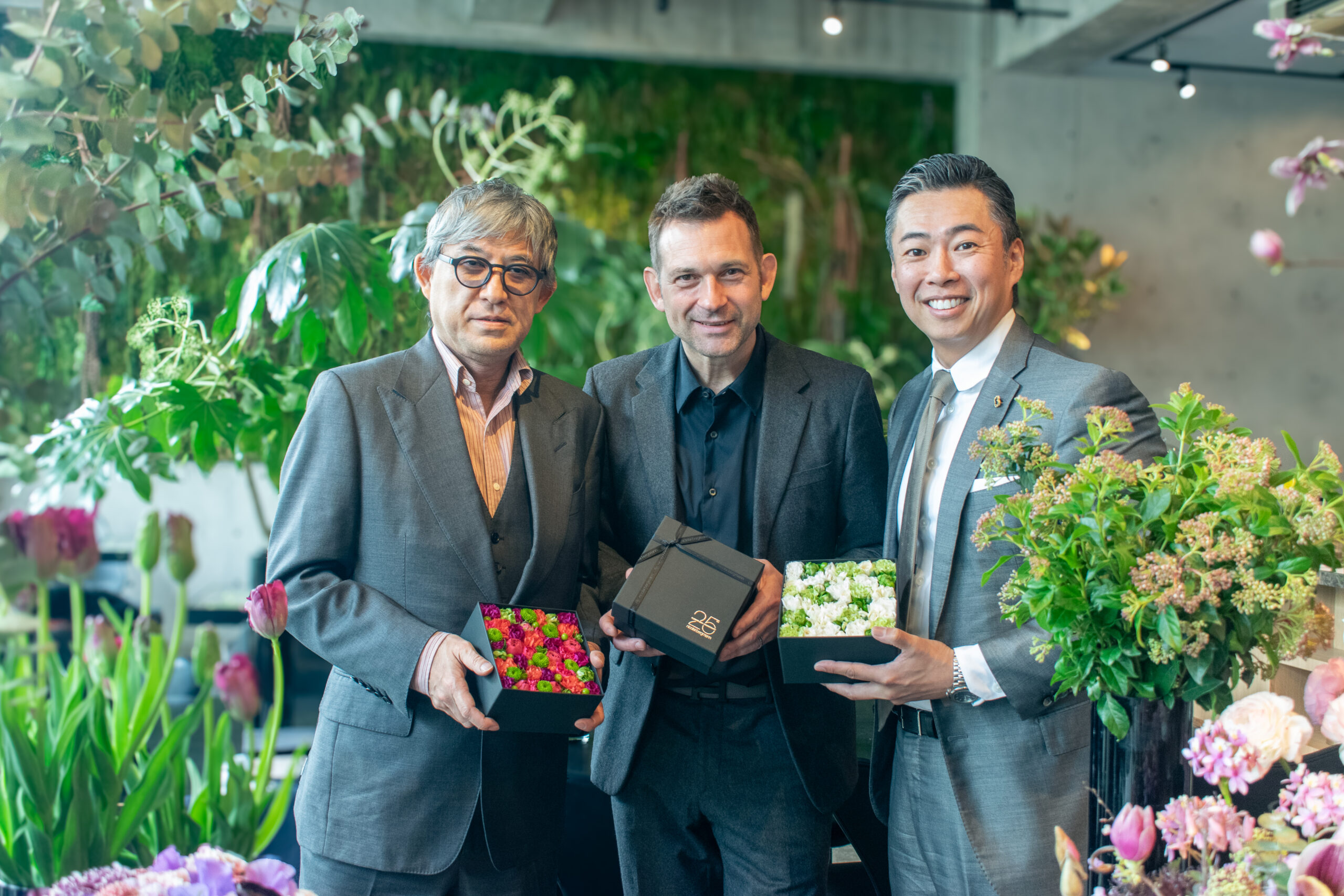
At the end, Nicolai selected a flower box that suited me. Even combinations I would never have chosen myself somehow felt perfectly right. Drawing out a version of myself I cannot see on my own—that, too, is the power of Nicolai Bergmann as an artist.
DK Sugiyama, Editor-in-Chief, My Philosophy
June 2026
Interview conducted at Nicolai Bergmann Flowers & Design Flagship Store
Interview & Editing: DK Sugiyama
Project Manager: Chiho Ando
Text: Eri Shibata
Photography: Hirona Goto
Production: My Philosophy® Editorial Team
Milestone (2007~)
View all Interviews
-
Vol.130 Mihoko Yamasaki
Creator of a Walking Method for Better Posture and Gut Health
-
Vol.129 Anis Uzzaman
Founder and CEO, Pegasus Tech Ventures
Founder and Chairman, Startup World Cup -

Vol.128 Nicolai Bergmann
Flower Artist
-
Vol.127 Hideki Wada
Psychiatrist
-
Vol.126 Hiroki Ogawa
General Manager, UMITO Kamakura Koshigoe|Chef, Le RESTAURANT
-
Vol.125 Seiichi Okada
Owner & Vice Chairman, Medical Corporation Seiseikai Inokuchinoma Hospital
President & CEO, Okada Medical Investment Co., Ltd. -
Vol.124 Masato Kato
President & CEO, Bechstein Japan Co., Ltd.
Klavierbaumeister -
Vol. 123 Akiko Yamamoto
Japan President, Van Cleef & Arpels, Richemont Japan
-
Vol.122 Akimi Fukuhara
Pianist
-
Vol.121 Sammy Miyamoto
Hairstylist & Entrepreneur / President, “momotaro salon”
-
Vol.120 Ryotaro Muramatsu
Artist / Founder of NAKED, INC. / Visiting Professor at Osaka University of Arts / Branding Director of Achi Village, Nagano
-
Vol.119 lecca
Singer-Songwriter
-

Vol.118 John Tanzella
President / CEO of the International LGBTQ+ Travel Association (IGLTA)
-

Vol.117 Marin Alsop
Conductor
-
Vol.116 Hajime Kinoko
Modern Artist, Kinbakushi (Rope Master), Rope Artist, Photographer
-
Vol.115 Shintaro Koizumi
Out Japan Co., Ltd Chairman
SK Travel Consulting Co., Ltd (Out Asia Travel) President
International LGBTQ+ Travel Association (IGLTA) Ambassador to Asia -
Vol.114 George Fujisawa
George Fujisawa, President of Fluid Power, Ltd.
-
Vol.113 Kazumi Arikawa
President, Albion Art Co., Ltd.
Founder, Albion Art Jewelry Institute
Chevalier of the Ordre des Arts et des Lettres (French Republic)
International Council Member, Metropolitan Museum of Art (New York) -

Vol.112 Leslie Kee
Photographer
-
Vol.111 Mitsuyuki Takada
President and CEO of Albalkan Corporation
-
Vol.110 Koji Sato
Head Chef of Yamagata Kappo Akasaka Ajisai
-

Vol.109 Krishna Ramachandra
Founder and Non-Executive Chairman of Digital Insights Ventures
-
Vol.108 Marc Einstein
Chief Analyst of ITR Corporation
-
Vol.107 Kentaro Sakai
President and CEO of Sakai Fish Farm Co., Ltd.
-
Vol.106 Ryuki Narita
President of Narita Koi Farm Co., Ltd.
-
No.105 Yoshihiro Tsumura
President and Group CEO, Aderans Co., Ltd.
-
Vol.104 Takatoshi Maruo
"Bali's Aniki (*Big Brother)"
-
Vol.103 Takashi Shimokawa
Principal of the preparatory school "Bulkan Juku" | President and CEO of Tass Group
-
Vol.102 Sayuri Yamaguchi
Ginza "CLUB GRÈS" Owner Mama
-
Vol.101 Koji Yamamoto
President and CEO of Global Partners Inc.
-
Vol.100 Tetsuo Gyotoku
Director of the Japan BE Research Institute
-
Vol.99 Kiyoshi Murano
Philosopher and Astronomer | Futurist
-
Vol.98 Hiroshi Yaegashi
Catalyst | Business Creator
-
Vol.97 Hiroyuki Sasaki
Chairman, Group Representative & CEO Pro Labo Holdings Co., Ltd.
-
Vol.96 Satoshi Yamaguchi
Chairperson of the Chitose Koyukai Social Welfare Corporation
-
Vol.95 Hideko Suzuki
Doctor of Literature | Critic
-
Vol.94 Kiyoshi Kurokawa
Doctor of Medicine | Honorary Professor at the National Graduate Institute for Policy Studies | Representative Director of the Health and Global Policy Institute
-
Vol.93 Hiroshi Senju
Japanese Painter | Professor at the Graduate School of Kyoto University of the Arts and Design
-
Vol.92 Takashi Yamane
Management Scholar | Certified Public Accountant | Professor at Waseda University Graduate School of Business and Finance (WBS) | Emeritus Professor at Keio University
-
Vol.91 Kazuo Noda
Honorary Chairman of the Japan Research Institute, a general incorporated foundation | Honorary Chairman of the Social Development Research Center, a general incorporated foundation | Honorary President of Tama University | Honorary President of The Graduate School of Project Design
-
Vol.90 Goichi Okada
Sales Office Manager, Prudential Life Insurance Co. | Senior Consulting Life Planner
-
Vol.89 Tatsumitsu Yamazaki
Honorary Chairman of the Japan Sailing Federation | Former Chairman of S&B Foods Inc.
-
Vol.88 Rick Blangiardi
Hawai‘i News Now Manager
-
Vol.87 Timothy Cottrell
Head of School, ‘Iolani School
-
Vol.86 John Gotanda
President of Hawai‘i Pacific University
-
Vol.85 George Ariyoshi
Former Governor of Hawaii
-
Vol.84 Taro Yoshida
President and CEO, Hawaii Hochi Ltd.
-
Vol.83 Naoki Kusano
President, HANAKEN | TOKYO TONKOTSU RA-MEN BANKARA Founder
-
Vol.82 Akira Kawashima
Doctor | Doctor of Medicine | Professor, Department of Acupuncture and Moxibustion, Faculty of Health Sciences, Tokyo Ariake University of Medical and Health Sciences
-
Vol.81 Reika Asai
President of Kirei Company, Inc.
-
Vol.80 Seiji Hayashi
President and CEO of Car Conveni Club Co., Ltd.
-
Vol.79 Shinichi Inoue
CEO of Peach Aviation Co., Ltd.
-
Vol.78 Katsuyoshi Fukuyama
President and CEO of Gardner Co., Inc.
-
Vol.77 Nahoko Ishikawa
Representative Director, Sixth Sense Labs, Inc.
-
Vol.76 Shin Yamagishi
Photographer
-
Vol.75 Mikio Kawai
Professional Surfer
-
Vol.74 Isao Aoki
Professional Golfer | Chairman, Japan Golf Tour Organization
-
Vol.73 Norihiko Sasaki
Executive Director, Editor-in-Chief of NewsPicks | Editor | Journalist
-
Vol.72 Yazaki Yasuhisa
Freelance Journalist | Editor
-

Vol. 71 Michael Anthony
Executive Chef, Gramercy Tavern
-
Vol.70 Kenji Takenaka
Flower Designer
-
Vol.69 Daniel T. Ebihara
Head of the New York Kendo Dojo, Entrepreneur, and Product Designer
-
Vol.68 Kyoko Gasha
Journalist | Film Director
-
Vol.67 Casey Taniguchi
President of Yomitime
-
Vol.66 Misao Ito
Writer | Art Producer
-
Vol.65 Narimasa Nakaoka
President and Representative Director, Suzukake Co., Ltd.
-
Vol.64 Takashi Sano
Chocolate Shop Owner-Chef
-
Vol.63 Toshiaki Kurosaka
Chairman of Porsche Japan K.K.
-
Vol.62 Taro Saito
Communication Designer. President and CEO of dof Inc., Co-CEO of CC Inc., Outside Director of VOYAGE GROUP Inc., Outside Director of Oceanize Inc., and Global Strategy Committee Member of the NPO TABLE FOR TWO.
-
Vol.61 Hideyuki Murakami
President and CEO of Iwataya Mitsukoshi Ltd. | Executive Vice President of Isetan Mitsukoshi Holdings Ltd.
-
Vol.60 Yoshiyuki Okuno
Owner-Chef of Ristorante La Brinca
-
vol.59 Rika Yukimasa
Culinary Researcher | CEO, REKIDS Co., Ltd.
-
Vol.58 Kazuko Tōdō
Manager and Proprietor of "Royal Box" and "Lindbergh" | Editor-in-Chief of 'LB Nakasu Newsletter
-
Vol.57 Takaharu Futaeda
CEO, Anny Group KFT
-

Vol.56 Kengo Kuma
Architect
-
Vol.55 August Hergesheimer
President and CEO of Abios Corporation | Ph.D. in Nutritional Science
-
Vol.54 Tomio Taki
Honorary Advisor, Takihyo Co., Ltd.
School Board Chairman, Taki Academy, Inc.
Board Member, Mikimoto (America) Inc. -
Vol.53 Tadashi Okura
President and CEO of Torikizoku Co., Ltd.
-
Vol.52 Hiroshi Sugimoto
Japanese Painter | Specially Appointed Professor at Yokohama University of Art and Design
-

Vol.51 Aureana Tseu
Hula Artist
-
Vol.50 Don Konishi
Fashion Designer | Visiting Professor, Nagoya University of Arts and Sciences
-
Vol.49 Sachio Senmoto
Chairman of the Board, Renova, Inc.
-
Vol.48 Naoyoshi Amari
Head Priest of Ichigyosan Senshuji Temple | Principal of Senshu Kindergarten
-
Vol.47 Takashi Maeno
Dean and Professor of the Graduate School of System Design and Management at Keio University.
-
Vol.46 Tomizo Yamaguchi
Third-Generation Head of Kyoto Confectionery "Suetomi"
-
Vol.45 Toshiharu Kokubun
Representative Director of Earth Holdings Co., Ltd.
-
Vol.44 Keita Obara
Professional boxer
-
Vol.43 Yuko Kibayashi Shin Kibayashi
Non-fiction writer and manga creator
-
Vol.42 “My Philosophy” Junki Yoshida
Chairman and CEO, Yoshida Group & Founder, Yoshida Sauce
-
Vol.41 Seisei Hanayama
Artist
-

Vol.40 Yoshiharu Sekino
Explorer | Anthropologist | Professor at Musashino Art University
-
Vol.39 Masaki Yokokawa
Representative of WELCOME Group
-
Vol.38 Tamami Sunoda
President and CEO of NOZZE (Marriage Information Center)| President, CEO, and Owner-Designer of Fashion Brand "JuviJuvi"
-
Vol.37 Shuichi Tsuji
Sports Doctor | CEO of Eminecross Co., Ltd.
-
Vol.36 Yuichiro Miura
Professional Skier | Principal of Clark Memorial International High School
-
Vol.35 Nobufumi Matsunaga
Educational Environment Setting Consultant | Founder of V-net Educational Consultation Office
-
Vol.34 Tetsu Mizutani
Suntory Beer Limited - President, Chief Executive Officer
-

Vol.33 Yukino Kikuma
Lawyer
-

Vol.32 Keiko Kouda
CEO of AsMama Co., Ltd.
-

Vol.31 Takami Hasebe
White Ship Inc. CEO | Art Producer
-

Vol.30 Aya Kinoshita
Representative Director of UHM Co., Ltd. | General Manager of Hotel Niwa Tokyo
-

Vol.29 Clara Komazaki
KoLabo Co., Ltd. Representative Director and President
-

Vol.28 Nobuko Tsutsumi
Lecturer at Showa Women's University, Aoyama Gakuin Women's Junior College, and Hosei University | Freelance Announcer | Essayist
-

Vol.27 Yu Kaida
Portrait photographer
-

Vol.26 Manabu Miyasaka
President and CEO, Yahoo Japan Corporation
-

Vol.25 Shuichiro Kimura
Representative Director of Boulangerie Eric Kayser Japon Inc.
-

Vol.24 Yohei Sadoshima
President and CEO of Cork, Inc.
-

Vol.23 Toshiaki Kanda
Representative of Kanda News Network | IT Journalist, Social Media Consultant
-

Vol.22 Emmy Suzuki Harris
Japanese Representative of Change.org
-

Vol.21 Masakazu Yanagisawa
Director of Global Prime Finance Sales at Deutsche Securities Inc. | Board Member of NPO good aging yells
-

Vol.20 Fumio Tateishi
Chairman of the Board of Directors, OMRON Corporation
-

Vol.19 Nobuyuki Idei
Founder & CEO, Representative Director of Quantum Leap Corporation
-

Vol.18 Rowland Kirishima
Photographer | Multi-Creator
-

Vol.17 Junko Masachika
Founder of Personal Styling | President and CEO of Fashion Rescue Ltd. | Dean of Personal Stylist Japan | Chairman of the Professional Personal Stylist Association
-

Vol.16 Kumiko Otsuka
President and Representative Director of Otsuka Kagu, Ltd.
-
Vol.15 Tsugihiko Fujiwara
President and CEO of AOI Pro. Inc.
-
Vol.14 Hideaki Inoue
President and CEO, Park Corporation
-
Vol.13 Edward Suzuki
Architect | Representative of Edward Suzuki Associates Inc.
-
Vol.12 Hiroshi Kato
Economist
-
Vol.11 Seiichi Shimada
Special Advisor at Nihon Unisys Ltd. | Former Chairman of the Japan Housing Finance Agency | Former Vice President of Mitsui & Co., Ltd. | Former President of Nihon Unisys Ltd.
-
Vol.10 Kanae Doi
Japan Representative, International NGO "Human Rights Watch" | Lawyer
-
Vol.9 Hitomi Kumasaka
Social Media Consultant | President and CEO of Social Media Research Institute Co., Ltd.
-
Vol.8 Yuriko Takahashi
CEO of E.OCT Inc.
-
Vol.7 Kazuhiro Hasegawa
Representative of the Corporate Power Institute | Senior Researcher at the Inter Professional Education Research Center, Chiba University of Commerce (CUC)
-
Vol.6 Kage
President and Representative Director of Caricature Japan, Ltd., and Representative Artist | Asian Ambassador for the National Caricaturist Network (NCN)
-
Vol.5 Fumi Sasada
President and CEO of BRAVIS International, Inc. | Chairman of the Japan Package Design Association
-
Vol.4 Kota Matsuda
Chairman of Tully's Coffee International | President of Quiznos Asia Pacific
-
Vol.3 Shigeru Uchida
Interior Designer
-
Vol.2 Naoyuki Agawa
Dean of the Faculty of Policy Management at Keio University.
-
Vol.1 Hitoshi Suga
Venture Capitalist